In industries where cleanliness, precision, and reliability are paramount, high purity piping plays a vital role. Whether it’s for food and beverage production, pharmaceuticals, biotechnology, or cosmetics, maintaining the purity of fluids and products is emphatically essential — and the piping system is the heart of that process.
At JDI, we specialize in comprehensive high purity piping solutions, offering end-to-end mechanical contractor expertise that spans the entire gamut of process piping requirements — from design and fabrication to installation, validation, and maintenance.
What constitutes high purity piping?
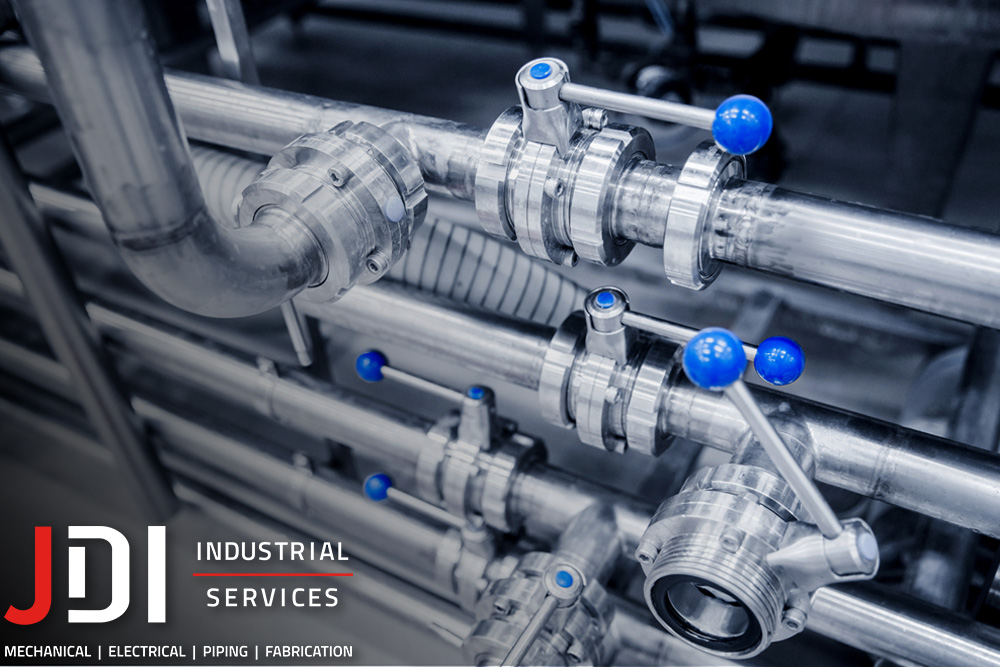
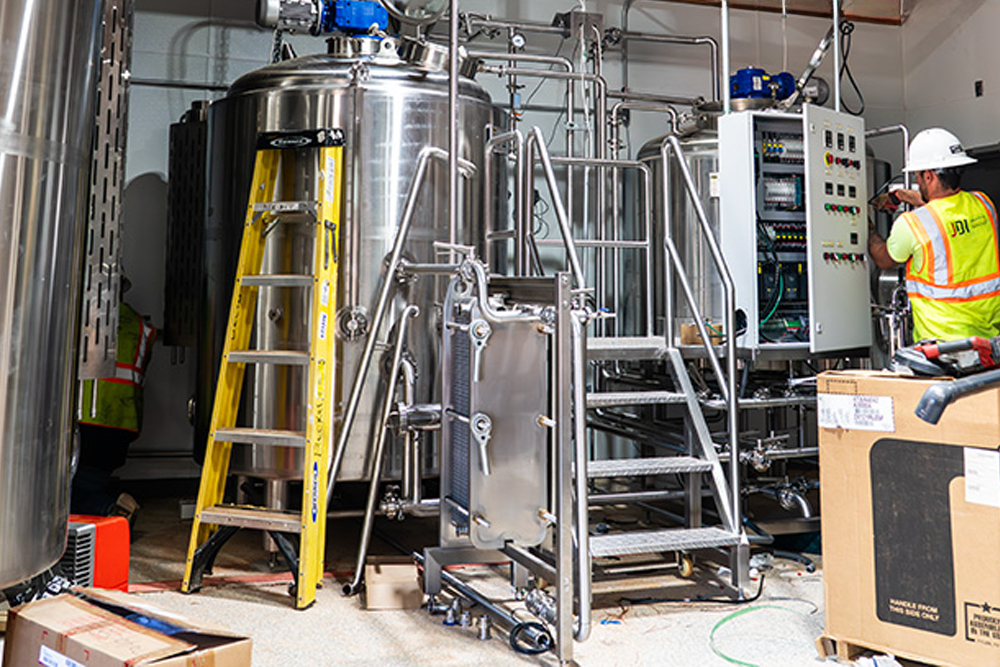
High purity piping refers to clean systems designed to transport fluids and materials in processes that demand high levels of hygiene and contamination control. Unlike standard industrial piping, high purity systems use smooth, crevice-free stainless steel tubing, handheld TIG or orbital welding, and sanitary fittings to prevent bacterial growth, corrosion, and contamination.
So, what is High Purity Piping? While there is no exact or one-size-fits-all definition, high purity pipe generally produces a controllable level of cleanliness. This requires alternative methods of fabrication, inspection, examination, and testing not covered elsewhere by B31.3.
These systems are essential in:
-
Food and beverage processing
-
Dairy and brewing
-
Pharmaceutical and biopharmaceutical production
-
Cosmetics and personal care manufacturing
-
Clean chemical processes

As you would expect, the world of B31.3 is tougher. Owners carry the burden of specifying the requirements of each of the piping systems, whereas under B31.9 the design is generally the responsibility of the Engineer. Therefore, the Owner must take a bigger involvement and commitment in the design of B31.3 systems.
Our Complete High purity Piping Capabilities
We provide turnkey high purity and process piping solutions, covering every aspect of the project lifecycle.
1. Design and Engineering
-
Custom layout and process flow design
-
Material selection (304, 316L, AL6XN, Hastelloy, etc.)
-
CAD and 3D modeling for precision layouts
-
Compliance with ASME BPE, 3-A, FDA, and cGMP standards
2. Fabrication
-
In-house or field fabrication of piping spools and assemblies
-
Orbital and manual TIG welding with full documentation
-
Polished interior surface finishes to specified RA values
-
Custom manifolds, skids, and valve clusters
3. Installation
-
Hygienic installation by certified welders and fitters
-
Precision routing to minimize dead legs and flow turbulence
-
Integration with clean-in-place (CIP) and steam-in-place (SIP) systems
-
Piping tie-ins, supports, and insulation
4. High Purity Testing and Validation
-
Hydrostatic and pneumatic pressure testing
-
Borescope weld inspection and passivation services
-
System flushing, cleaning, and sanitization
-
Documentation packages for validation (IQ/OQ/PQ)
5. Maintenance and Modifications
-
Preventive maintenance and system audits
-
Expansion, retrofits, and process upgrades
-
On-site troubleshooting and emergency repairs
-
Passivation and revalidation services
Quality, Compliance, and Precision
Our high ourity piping systems are built to meet or exceed industry standards such as:
-
ASME BPE (Bioprocessing Equipment)
-
3-A Sanitary Standards
-
FDA cGMP guidelines
-
ISO 9001 Quality Management Systems
Particularly, JDI makes sure that every weld, fitting, and flange is inspected and documented to ensure traceability, performance, and long-term reliability.
Welding and Joining high purity Piping
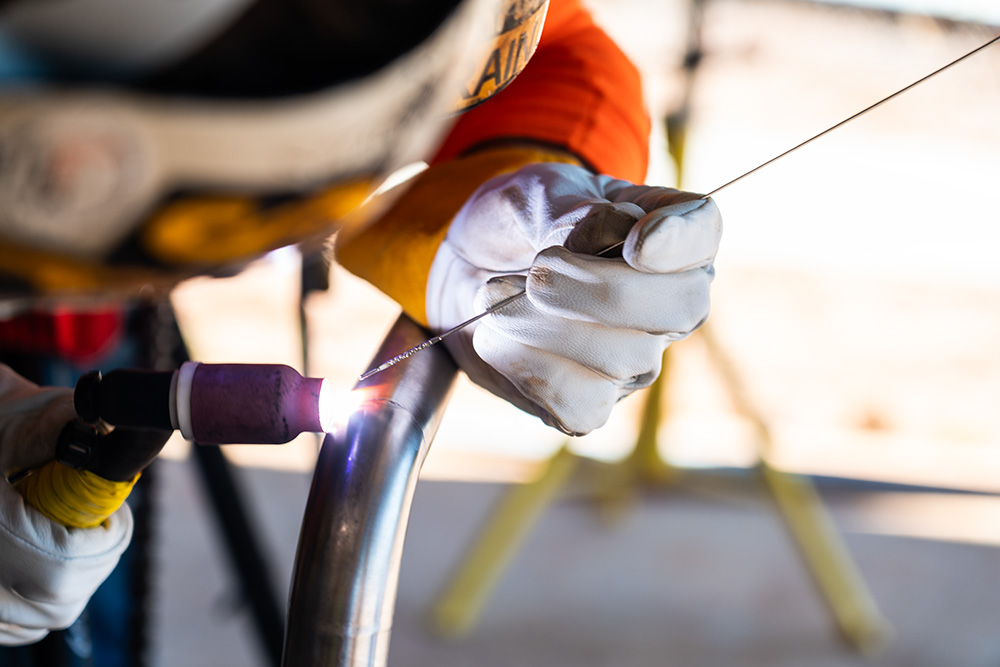
The integrity of a high purity piping system depends heavily on how it’s joined and welded. Moreover, in high purity and hygienic applications, even the smallest crevice or imperfection can harbor contaminants, compromise flow, and lead to costly downtime or product loss.
Therefore, high purity piping installation demands specialized joining techniques, precision craftsmanship, and rigorous quality assurance.
1. The Importance of Hygienic Welding
Firstly, unlike conventional industrial piping, high purity systems are welded to achieve:
-
Smooth, crevice-free joints that eliminate microbial harborage points
-
Full penetration welds that maintain the strength and cleanability of the system
-
Consistent weld geometry to ensure laminar flow and minimal turbulence
The objective: a weld so clean it becomes indistinguishable from the tubing itself.
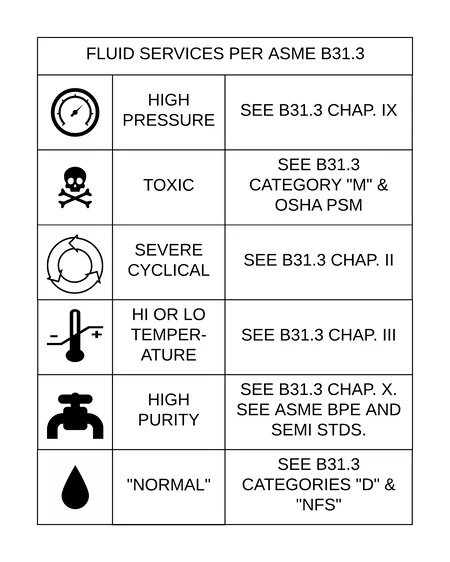
2. Knowledge of Fluid Service types:
Secondly, you must understand the service types to provide exceptional safety and performance:
-
Category D Fluid Service: This type of fluid service is nonflammable, non-toxic, and not damaging to human tissue. In addition, this fluid does not exceed 150 PSI for design gage pressure, design temperature is not greater than 366 degrees Fahrenheit. Also, the fluid temperature caused by anything other than atmospheric pressure is not less than -20 degrees Fahrenheit.
-
Category M Fluid Service: This service is one in which the potential for personnel exposure is judged to be significant and in which a single exposure can seriously harm people. You MUST recognize the potential for toxic fluid exposure with this service.
-
Elevated Temperature Fluid Service: a fluid service in which the piping metal temperature is sustained equal to our greater than the threshold temperature.
-
High Pressure Fluid Service: Fluid service that which the owner specifies the use of Chapter IX for piping design and construction.
- High Purity Fluid Service: Fluid service that requires alternative methods of fabrication, inspection, examination, and testing not covered elsewhere in the ASME codes. Consequently, the intent is to produce a controllable level of cleanliness for high purity, ultra high purity, hygienic, or aseptic. Further info is in chapter 10 of the ASME B31.3 code book.
- Normal Fluid Service: Essentially, most fluid service pertaining to most piping is covered by this code as long as it is not able to be designated under any of the other service types.
3. Common Joining Methods
a. Orbital TIG (GTAW) Welding
Thirdly, we have the industry standard for sanitary and high-purity process piping.
-
Process: An automated or semi-automated welding head rotates 360° around stationary tubing while simultaneously maintaining a controlled, repeatable TIG arc.
-
Shielding Gas: Ultra-pure Argon (99.999%) ensures an oxygen-free environment, preventing oxidation or discoloration.
-
Purge Gas: Internal purge maintains a protective atmosphere inside the tube for clean, oxidation-free weld beads.
-
Benefits:
-
Consistent, repeatable welds
-
No filler metal required (autogenous welding)
-
Minimal heat input and distortion
-
Excellent for 304L, 316L, AL6XN, and similar stainless steels
-
b. Manual TIG (GTAW) Welding
Whereas orbital is useful for spacious areas, manual TIG welding is conversely useful in areas with limited accessibility or for complex field modifications.
-
Requires highly skilled sanitary welders with certifications (ASME Section IX, AWS D18.1).
-
Purge dams or caps are used to maintain internal gas shielding.
-
Typically used with sanitary clamp fittings, elbows, tees, or reducer transitions.
-
Welders document each weld with traceability logs and inspection records.
c. Clamp or Ferrule Connections (Tri-Clamp Fittings)
For sections requiring disassembly, cleaning, or inspection.
-
Comprise two ferrules, a gasket (EPDM, Viton, PTFE), and a clamp.
-
Provide a sanitary seal that’s easy to clean and maintain.
-
Commonly used on CIP/SIP lines, instrumentation points, and skid connections.
4. Welding Preparation and Fit-Up
Fourthly, quality starts with preparation:
-
Tube Cutting: Orbital saws or precision cutting tools ensure square, burr-free cuts.
-
Cleaning: Tubing is cleaned with isopropanol or acetone wipes to remove oils and particulates.
-
Fit-Up: Tubes are aligned with high-precision clamps; internal mismatch is kept below 10% of wall thickness.
-
Purge Setup: Ends are sealed with purge plugs or dams; argon flow is adjusted for optimal back-purge.
5. High purity piping Inspection and Finishing
Equally important, every weld is verified for compliance with purity standards:
-
Visual Inspection: 100% visual review per ASME BPE and AWS D18.2 guidelines.
-
Borescope Examination: Internal inspection ensures no oxidation, pitting, or undercut.
-
Surface Roughness Testing: Confirms welds meet required Ra values (often ≤ 25 µin).
-
Passivation: Nitric or citric acid passivation restores the chromium oxide layer, enhancing corrosion resistance.
-
Documentation: Weld maps, logs, and inspection reports provide complete traceability.
6. Standards and Compliance
Finally, a major key point is that all welding and joining work is performed to recognized sanitary and high-purity standards:
-
ASME BPE (Bioprocessing Equipment)
-
AWS D18.1/D18.2 (Welding Standards for Sanitary Applications)
-
3-A Sanitary Standards
-
FDA and cGMP requirements
These standards ensure that systems meet the strict hygiene, safety, and quality demands of regulated industries.
 Conclusion
Evidently, sanitary piping is more than just a network of tubes — it’s the foundation of safe, efficient, and code ready process operations. At JDI Industrial Services, we don’t just install piping; we undoubtedly build systems that uphold the highest standards of purity, performance, and accuracy.
From simple skid assemblies to complete process plants, we cover the entire gamut of high purity, sanitary, and process piping needs — consequently, we are making systems you can trust to keep your operation flowing cleanly and efficiently.
High purity pipe welding explicitly requires:
-
Precision-engineered equipment
-
Highly trained, certified welders
-
Strict adherence to hygienic standards
-
Rigorous inspection and documentation
At JDI Industrial Services, we combine welding technology with decades of field expertise to deliver high purity piping systems that are clean, compliant, and built to perform significantly. For that reason, we have a 100% retention rate with our clients.
Citations:
Becht, C, IV. “High-Purity Piping.” Process Piping: The Complete Guide to ASME B31.3, Fourth Edition. Ed. Becht, IV, C. ASME, 2021